Massage Gun Specs Explained: Stroke Length and Speed
Massage gun specs explained without the jargon: what a 16 mm stroke and a handful of speed settings actually change about how a gun feels, so you can compare models without overbuying.
 By WellnessTrim
7 min read
One listing says 16 mm stroke. Another says five speeds, 1,800 to 2,800 RPM. A third costs several times more and is vague about both. If you have read those lines and had no idea what they mean for how a gun feels in your hand, that is the gap this article fills — and it is the gap that pushes people into overbuying or giving up.
We research published information rather than testing devices ourselves. Everything below comes from the brands' own product pages and guidance, checked on the date shown in our massage gun buying guide, where seven models sit side by side on the same specs.
What stroke length measures
Stroke length — brands usually call it amplitude — is how far the head travels back and forth on each stroke. It is a distance in millimetres, and it is the single spec that most changes how a gun feels in use.
Therabody lists its full-size Theraguns at 16 mm and the Theragun Mini at 10 mm. On the brand pages we checked, RENPHO gives the Active+ as 10 mm and Opove gives the M3 Pro as 12 mm. A longer stroke travels further on each pass; a shorter one feels lighter and buzzier.
Two things to know before you compare. Not every brand publishes amplitude — Hyperice and Ekrin did not state it for the models in our roundup, so you cannot line them up against a 16 mm gun on this spec alone. And the millimetre figure is the length of the stroke, not how strong the motor is. That is a separate number, covered further down.
Try This: Open the brand's own product page and look for an amplitude or stroke figure in millimetres before you read any review. If the brand does not publish one, read that as missing information rather than as zero.
What speed settings control
Speed settings control how many times the head moves per minute. Most guns in our roundup list five; the Theragun Mini lists three, and Therabody says more speeds unlock when the device is connected to its app.
The units are not standardised. Hyperice, Ekrin, RENPHO and Opove quote RPM on their own pages, while Therabody uses percussions per minute, or PPM. Where a range is given it can be wide: Hyperice lists 1,500 to 2,500 RPM for the Hypervolt 3, and Ekrin lists 1,400 to 3,200 RPM for the B37.
That matters because the top number is not a score. A gun with a higher stated maximum is not automatically better for you; it just has a higher stated maximum. What you are really comparing is the spread of settings and how finely you can step between them. Five steps between a low and a high point gives you more room to find a comfortable middle than three.
Try This: Start on the lowest speed and move up one step at a time. Your device's manual is the authority on which settings and attachments to use.
How the two work together
Stroke and speed read as a pair, because together they make one sensation. A long stroke at a low speed feels slow and deep. The same stroke at a high speed feels brisk. A short stroke at a high speed feels fast and surface level — a quick tap rather than a long push.
This is why comparing one gun's stroke against another gun's speed tells you nothing. A 16 mm gun on its second speed and a 10 mm gun on its fifth are not doing the same thing, even though both are switched on.
So decide which end of that trade-off you want before you look at prices:
- Long stroke, several speeds. The widest range to move between, in a heavier body. The 16 mm Theraguns are this option.
- Short stroke, fewer speeds. The same idea in a smaller package that is easier to hold and to pack. The 10 mm Mini is the example on our list.
- Pressure under your own hand. Stroke and speed say nothing about what happens when you lean in. For that you need a stated stall force, which not every brand gives.
Our massage gun buying guide puts stroke, speed, weight and battery for all seven models in one table if you want to compare side by side rather than spec by spec.
Try This: Write the stroke in millimetres and the number of speeds in a two-column list for each candidate. The one missing a figure is the one to research further, not the one to buy on price.
Stall force, noise and weight
Stall force is how hard you can press before the motor stops. It is separate from stroke and speed, and it is the spec most often left out: Opove states 70 lb for the M3 Pro, the highest figure on our list, while Therabody, Hyperice and Ekrin did not state stall force for the models we checked.
Noise works the same way. Some brands publish a decibel figure and some do not. Hyperice states 48 dB for the Hypervolt 3, RENPHO states a figure for the Active+, and Therabody lists none for the models in our roundup. Where a number is quoted, check whether it is a single figure or a range across speeds.
Weight decides whether you can hold the gun up long enough to reach your own shoulders and upper back. The minis on our list are around 1 lb; the premium models are several times heavier. Handle shape matters too — Ekrin's angled handle on the B37 exists because reaching your own back is awkward.
Try This: If you plan to press firmly, check whether the brand publishes a stall force. If it does not, do not assume it is either high or low.
Massage gun specs explained for desk-related tightness
Most first-time buyers are not athletes. They sit at a desk, their shoulders and upper back feel tight by the end of the day, and they want one device that is simple to use at home. That profile changes which specs deserve your attention.
- Reach comes first. The real question is whether you can comfortably hold the gun behind your own shoulder for a minute or two. Weight and handle shape decide that more than stroke does.
- Then stroke, at the level you settled on above. A compact 10 mm gun and a full-size 16 mm gun are both plausible choices; pick the feel you want rather than the bigger number.
- Speeds as steps, not as a score. Five settings give you room to work up gradually; three is workable but less adjustable.
- What is on the end of the arm. A softer head for areas close to bone and a ball for general use covers most of it — that is Therabody's own guidance on head shapes.
Before the first session, read the brand's precautions. Therabody advises asking a medical professional first if you have a recent injury or surgery, open wounds or bruising, a bone fracture, take blood-thinning medication or are pregnant, and lists direct application to the face, head, throat, neck or genitals as a contraindication. RENPHO says not to apply its device to the head, face, throat or cervical spine, and to consult a doctor first if pregnant or if you have a heart condition, pacemaker or metal implants. Follow the manual that comes with your device.
Try This: Read the brand's precautions page as well as the manual before the first use. Both Therabody and RENPHO list situations where a healthcare professional should be asked first.
Reviews, attachments and whether they work
Most massage gun reviews you will read online repeat the same three things: the price, the number of speeds and the number of attachments. Far fewer tell you the stroke in millimetres, whether the brand publishes a stall force, or how the gun's weight feels at arm's length. Those are the details that decide whether a device suits you.
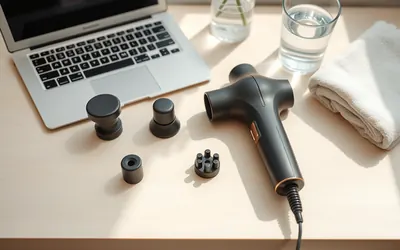
On massage gun attachments, the count matters less than the shapes. Therabody's guidance on choosing a massage gun attachment is that a softer or dampener head suits areas near bone, a ball suits general use and a thumb or bullet head suits small spots. Then check the box: the Theragun Prime ships with two attachments, while the PRO Plus lists seven, and some heads are sold separately.
As for the phrases you may have searched — do massage gun work, or does massage gun work — no spec sheet answers that, and we do not make that claim. What we can do is show you exactly what each brand states about its own device, and send you to the brand's own safety guidance.
Try This: Count only the attachments in the box, not the ones in the photos. Then check whether the shapes you would actually use are included or sold separately.
Why trust this comparison
Fair question, and it deserves a direct answer. We do not hands-on test these devices, and we say so at the top of the buying guide. Every figure in that guide and in this article comes from the brand's own US product page or its own guidance pages, with the date we checked it. Where a brand does not publish a spec — Hyperice and Ekrin on amplitude, Therabody on noise — we write not stated instead of estimating. We also flag it when a brand page contradicts itself, as Therabody's Mini page does on weight and battery time.
Brands cannot pay for a spot in the guide. Some of the guide's links may earn a commission, and each one is labelled there; the links in this article go to brand pages and earn nothing. You can check our work by opening the same pages — if a number here does not match the brand, the brand is right and we want to know.
What this approach cannot do is tell you how a gun will feel in your hand. That is why you get the spec logic and the brands' own numbers, rather than a verdict on feel from us.
Try This: Before trusting any roundup, including ours, check that it names the exact model generation and the date its specs were checked. If neither is there, the numbers may be out of date.
The Bottom Line
Stroke length sets how deep each pass feels and speed settings set the pace, and neither number on its own tells you whether a gun will suit you. Compare within your own use — how you will hold it, how much you want to adjust the intensity, and what actually comes in the box — then read the brand's safety guidance before the first session. If you have an injury or a condition, ask a healthcare professional before using one.
General information only, not medical advice. Talk to your doctor before making big changes to your diet, exercise or sleep, especially if you have a health condition or take medication. See our medical disclaimer and editorial policy.