Percussion Massage Gun Specs: Stroke Length and Speed
A 16 mm stroke and five speed settings only start to mean something once you know how they change the feel of a percussion massage gun in your hand.
 By WellnessTrim Editorial Team
7 min read
"16 mm stroke" is the kind of phrase that sits in a listing without explaining itself. You can see the number, a speed count, a force figure in pounds and a battery claim, but none of it tells you whether the device will feel flimsy in your hand or like too much on a quiet evening after a long day at the desk. You want to avoid spending a lot on something that turns out to be either, and you would rather understand the specs than guess.
This page decodes the numbers that actually change how a handheld massage gun feels, says plainly which brands publish which figures, and points you to the full side-by-side comparison. We research published information rather than testing devices ourselves, so read this as general information, not medical advice.
What a percussion massage gun's stroke length means
Stroke length, which brands usually call amplitude, is how far the head travels back and forth on each stroke. It is the spec that most changes the feel. Therabody states 16 mm for its full-size Theraguns, including the Prime and the PRO Plus, and 10 mm for the Mini. Opove states 12 mm for the M3 Pro. Hyperice and Ekrin did not state an amplitude on the product pages we checked, so we leave that blank rather than filling it in for them.
What the figure means in practice: a longer stroke travels further on each pass, which reads as a deeper, slower-feeling action, while a shorter stroke reads as lighter and buzzier. Neither is automatically better. If you want a light, quick pass over the shoulders and upper back after a day at a screen, a compact 10 mm portable percussion massage gun covers that ground. If you prefer the feel of a longer throw, the 16 mm models are the ones to look at.
Try This: Decide first whether you want a light, quick pass or a slower, deeper one. That answer narrows your stroke length faster than any spec table.
Speed settings: count is not the whole story
The number of speeds is a count of preset levels, and more levels mostly means finer steps between them. The range behind the count matters more, and brands quote it in different units: Renpho, Hyperice, Ekrin and Opove use RPM, while Therabody uses PPM. Compare a gun with others in the same unit rather than converting between them.
- RENPHO Active+: five speeds, 1,800–2,800 rpm
- Hyperice Hypervolt 3: five speeds, 1,500–2,500 rpm
- Ekrin B37 (v2): five speeds, 1,400–3,200 rpm
- Theragun Mini (3rd Gen): three speeds at 1,750, 2,100 and 2,400 PPM
Theragun Prime and PRO Plus each list five speeds, and Therabody notes that more speeds unlock when the gun is connected to its app. Before paying more for a higher top speed, ask whether you will ever use it: the top of any range is a ceiling, not the setting you will live in.
Try This: Start on the lowest speed and step up one level at a time until you reach the setting you would choose again tomorrow.
Stall force: how hard you can lean in
Stall force is how much pressure the motor takes before it stops, and it answers a simple question: will this gun bog down when I press on it? Only some brands publish it. On the pages we checked, Renpho states 50 lb for the Active+ and Opove states 70 lb for the M3 Pro, while Therabody, Hyperice and Ekrin did not state a stall force for these models.
A blank is not a zero. A brand that does not publish stall force has not told you the gun is weak — it has simply not given you a number to compare, so avoid ranking it as if it had. If leaning into the massage is part of how you like to use a percussion massage gun, a stated higher figure gives you something concrete to judge. If you prefer a light pass, stroke length and noise will matter more to you than stall force.
Try This: Press the head into your palm at the pressure you would really use. If the motor slows or cuts out, that is its limit — ease off rather than fighting it.
Weight, handle and massage gun attachments
A massage gun you cannot hold comfortably is one you will not use. Listed weights in this group run from about 1 lb for the minis to 3.64 lb for the Theragun PRO Plus, with the Hypervolt 3 at 2.0 lb and the Opove M3 Pro at 2.43 lb. A pound sounds trivial until you are holding the device at shoulder height for a few minutes.
Handle shape matters as much as weight. Ekrin's 15-degree angled handle is designed to help you reach your own back, and Therabody's buying guide points to handle design for hard-to-reach areas such as the lower back. Massage gun attachments are the other thing to check, and shape counts for more than quantity: a dampener or soft head for areas near bone, a ball for general use, and a thumb or bullet head for small spots.
Then look at what is actually in the box. Theragun Prime ships with two heads and sells Wedge, Thumb and Supersoft separately; RENPHO includes five; Opove includes six; Theragun PRO Plus includes seven, among them heat and vibration attachments, with the Cold Plus attachment sold separately.
Try This: Count the heads you would genuinely reach for before you count the ones in the box. Two useful massage gun attachments beat six you never swap in.
Noise and battery claims, read closely
Compare noise only where the brand states a decibel figure, and note whether it is a single number or a range across speeds. On the pages checked: Renpho states 45 dB or less, Hyperice states 48 dB for the Hypervolt 3, Ekrin lists 35–55 dB and Opove lists under 55 dB. Therabody did not list a decibel figure for the models here, which is a gap rather than a verdict.
Read battery claims as best-case figures. Therabody notes that its battery life is tested at the lowest speed setting and varies with use, and its Mini page lists two different weights and battery times — we record both rather than picking the flattering one. Charger type is worth a look if you travel: Theragun models use USB-C, the Hypervolt 3 uses an 18V wall charger for the gun with USB-C for its heated head, and Ekrin uses USB-C PD.
Try This: If quiet use matters because others are asleep, use a single stated decibel figure as the tiebreaker and read a range as "depends which speed you pick".
Matching intensity without overbuying
Write down the two things you will actually do with the gun — a short evening pass over your shoulders, or longer sessions on your legs after a run — and the specs start sorting themselves.
- Quiet and light: RENPHO Active+, 45 dB or less as stated by Renpho, with a 10 mm stroke and five attachments
- A deeper feel: Theragun Prime, 16 mm stroke with real-time pressure feedback
- Firm pressure: Opove M3 Pro, with the highest stated stall force in this group at 70 lb
- Reaching your own back: Ekrin B37 (v2), 15-degree angled handle and up to 8 hours of run time per Ekrin
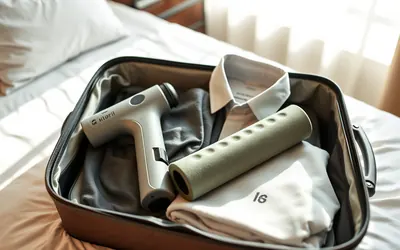
- Travel: Theragun Mini (3rd Gen), about 1 lb, with a travel lock and a TSA-approved size label from Therabody
List prices on the day we checked ran from $79.99 to $649.99, so the spread is wide enough that matching matters. The full table, spec by spec, is in our guide to the best massage guns.
Whatever you pick, keep sessions short and follow the manual. Bob and Brad advise about 10–20 seconds per spot and a maximum of 2 minutes per muscle, and skipping bony areas such as the spine and kneecaps. Therabody lists direct application to the face, head, throat, neck or genitalia as a contraindication and advises asking a medical professional first if you have a recent injury or surgery, open wounds or bruises, a bone fracture, take blood-thinning medication or are pregnant. See our medical disclaimer for the general-information caveat, and check with a healthcare professional if you have an injury or condition.
Try This: Name the two situations you will use it in before you open any comparison table. It is the quickest way to stop paying for range and power you will never touch.
How do I know this isn't a paid placement?
It is a fair question, and the honest answer starts with what we do not do: we have not physically tested these devices. What we do is compare the specs each brand publishes on its own US product page, on a dated check, and write "not stated" where a figure is missing instead of estimating it. That is why you will see blank cells for stall force on the Therabody, Hyperice and Ekrin entries rather than a guess dressed up as a number.
On money: the links on this site are affiliate links, and we may earn a commission if you buy through them, at no extra cost to you. Brands cannot buy a spot in the comparison, and a commission rate does not move a product up the list. Where a brand's own page contradicts itself — as Therabody's Mini page does on weight and battery — we record both figures rather than the more flattering one, and we leave customer review numbers out of the spec columns because they are not brand specifications.
The check date, the full comparison and the reasoning behind each pick sit in the best massage guns guide. If a spec you care about is not there, it is because no brand page stated it.
Try This: Open the brand's own product page next to any review and look for the spec the review leaves out. If it is missing there too, that is a gap in the published data, not a hidden feature.
The Bottom Line
Stroke length tells you how the massage feels, stall force tells you how much pressure the motor will take, and the speed count tells you least of the three. Match those to how you will actually use a handheld massage gun, keep sessions short, and check the full comparison before you spend.
General information only, not medical advice. Talk to your doctor before making big changes to your diet, exercise or sleep, especially if you have a health condition or take medication. See our medical disclaimer and editorial policy.