How to Choose a Portable Massage Gun for Carry-On Travel
You want to bring your recovery tools on work trips, but the massage gun is bulky and heavy, so it stays home. A portable massage gun is a packing decision before it is a specs decision.
 By WellnessTrim Editorial Team
6 min read
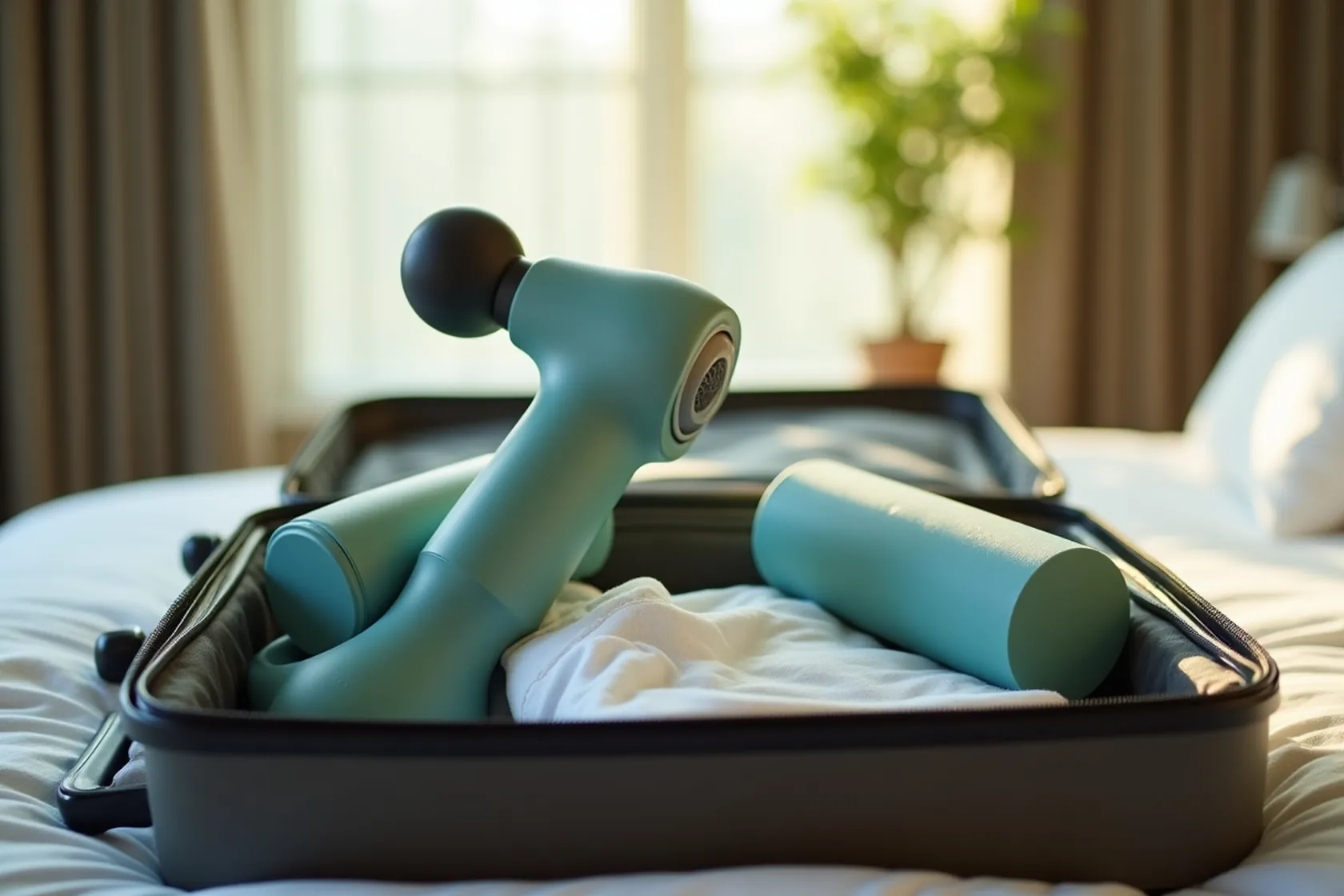
You pack the shoes and the resistance band, then stand over the open suitcase doing the maths on a heavy tool you may not even switch on. The massage gun goes back in the drawer. That is not a discipline problem — most full-size guns are built for a living room, not a carry-on.
This guide is the practical path: choosing a lightweight, compact massage gun — or a compact foam roller if you would rather not carry a battery at all — that fits in a carry-on and can be used in a hotel room. No promises about a specific model, just the specs that decide whether it gets packed, and the brand guidance to follow once you are there.
What a portable massage gun has to get right
Packing is where most of these devices fail. Therabody lists the Theragun Prime (6th Gen) at 32 oz (907 g) — the brand's own description puts the device at 0.907 kg (1.99 lbs) without attachments. The Mini (3rd Gen) is listed at about 1 lb on the same site. One number, and a completely different packing problem.
Before you compare anything else, check four things on the product page — our massage gun buying guide lists them side by side for each model:
- Weight, stated the same way. Some brands quote pounds, some kilograms, some "without attachments". Convert once so you are comparing like with like.
- A case in the box. Therabody's What's Included list for the Prime is device, two attachments and a cable — no case. The Mini ships with a soft travel case.
- A travel lock. Theragun Mini has one that stops it powering on in a bag, which is the difference between packing it and wrapping it in a jumper.
- How it charges. USB-C means one less charger in the bag; a dedicated wall charger means one more thing to remember.
Try This: Put the gun, its case and its charger on the kitchen scale before you commit, and compare that total rather than the bare device weight.
Mini, handheld, or full-size: matching the tool to the trip
Listings blur together because they use several names for a shrinking category: mini massage gun, handheld massage gun, portable percussion massage gun, miniature massage gun. None of those is a standard. They describe a format, so the label tells you less than the spec sheet behind it.
The labels are only a rough starting point. Check the numbers behind them:
- The miniature end. Therabody's Mini (3rd Gen) is the clearest example: a 10 mm stroke, a travel case and a travel lock, and the brand labels it TSA-approved size. The Hyperice Hypervolt Go 3 is listed at 1.6 lb with a carry case and USB-C charging.
- Handheld guns with a case. The RENPHO Active+ is listed at 1.5 lb with a 10 mm stroke, five attachments and a carry case — lighter than several full-size models on our list. Weigh the published number rather than trusting the word on the box.
- Full-size. The Theragun PRO Plus is listed at 3.64 lb. Superb in a living room, a lot of bag in a carry-on.
If you would rather not carry a battery at all, a compact foam roller is the low-tech alternative — nothing to charge, nothing to lose in a hotel drawer. It does less, and it never needs a travel lock.
Try This: Search the brand's own product page for the word "case" before you buy; a gun without one either travels loose or needs a case you buy separately.
Stroke depth and stall force, in plain terms
Two specs decide how a gun feels when you press it against a shoulder. Amplitude is how far the head travels on each stroke: Therabody's full-size Theraguns are 16 mm, and the Mini is 10 mm. A longer stroke feels deeper and a shorter one feels lighter and buzzier, which is exactly why the small guns suit a bag but not everyone's preference.
Stall force is how hard you can lean in before the motor stops. It is published by some brands and not others: Renpho lists 50 lb for the Active+, Opove lists 70 lb for the M3 Pro, and Therabody, Hyperice and Ekrin did not state it for the models we checked. When a brand stays quiet, leave the figure as unknown rather than assume.
Try This: Compare mini with mini and full-size with full-size — a 10 mm stroke and a 16 mm stroke are different tools, so a spec-by-spec comparison across formats tells you little.
Noise, battery and charging in a hotel room
Thin walls make noise a real spec. Compare decibels only where the brand publishes one, and note whether it is a single figure or a range across speeds: Hyperice states 48 dB for the Hypervolt 3 and Renpho states 45 dB or less for the Active+, while Ekrin gives a range. Therabody did not publish a dB figure for the models checked, so there is nothing honest to put in that column.
Read battery claims as best-case figures. Therabody notes that its battery life is tested at the lowest speed setting and that actual life varies by use, and the Mini's own page gives two different weights and two different run times — plan for the lower number. Charging matters as much as capacity: USB-C on the Theragun Mini, the RENPHO Active+ and the Ekrin B37 means the same cable as your phone, while the Hypervolt 3 uses an 18V wall charger for the gun.
Try This: Pack one USB-C cable and confirm every device on the trip can share it; a dedicated charger is the easiest thing to leave in a hotel wall socket.
Attachments: fewer, better shapes
Attachment counts are marketing. What matters is the shape of each head and whether the useful ones are in the box. Therabody's Prime ships with two (a dampener and a standard ball) and sells the wedge, thumb and supersoft heads separately, while the other guns on our list ship with three to seven. A soft head for areas near bone, a ball for general use and a small head for tight spots covers most of what you would do in a hotel room.
Try This: Lay the attachments out before you pack and take only the two you actually use; the rest are better left in the case at home.
Using it in a hotel room: short, on muscle, by the book
Brand safety guidance travels with the device. Therabody advises asking a medical professional before use if you have a recent injury or surgery, an open wound or bruise, a bone fracture, are taking blood-thinning medication or are pregnant, and lists the face, head, throat, neck and genitals as areas not to apply it. Renpho similarly says not to use its device on the head, face, throat or cervical spine, and to consult a doctor first if you are pregnant or have a heart condition, pacemaker or metal implants.
Bob and Brad's published guidance suggests about 10–20 seconds per spot and a maximum of 2 minutes per muscle, and skipping bony areas such as the spine and kneecaps. Follow the manual that comes with your device, and check with a healthcare professional if you have an injury or condition.
Try This: Set a phone timer before you start, so a short session stays short even when the room is quiet and you have lost track of time.
How we pick, and how to check our work
Fair question, and it deserves a straight answer: we have not physically tested these devices. Our massage gun buying guide is built from what each brand publishes on its own site — amplitude, stall force, speeds, weight, battery, stated noise, attachments and list price — checked on the date at the top of the page. Warranty terms come from the brand's own warranty page where the product page links to one. Where a brand does not state a spec, the guide says so instead of guessing, which is why you will see "not stated" in the comparison table more often than a confident-sounding figure.
On money: that guide contains affiliate links, and we may earn a commission if you buy through them. Brands cannot pay for a spot, and a commission does not move a product up the list. The strongest check we can offer is that you can repeat the work — open the brand's page and compare the spec we quote. If a figure no longer matches, the page changed and the guide should be updated.
Our review process and affiliate disclosure sit alongside the guide, and we tell you plainly what has not been tested rather than implying a lab result we do not have.
Try This: Open the brand's product page next to any comparison table and check two specs yourself; it takes a minute and tells you whether the source is being quoted honestly.
The Bottom Line
Aim for weight and a case first, then check stroke depth, stated noise and how it charges — those are what decide whether a gun earns its place in a carry-on. Where a number is not published, it stays unknown rather than being filled in with a guess. When in doubt, go smaller: the full-size guns are happiest at home.
General information only, not medical advice. Talk to your doctor before making big changes to your diet, exercise or sleep, especially if you have a health condition or take medication. See our medical disclaimer and editorial policy.