Searching "Massage Gun for Muscle Recovery"? Start Here
If you have been searching "massage gun for muscle recovery" after an occasional run, this is a short, source-based routine for tight calves and sore feet, with an honest note on what the published sources do not cover.
 By WellnessTrim
6 min read

It is the morning after an occasional run: your calves feel tight and there is soreness along the sole of one foot. You have a foam roller in the corner, a massage gun in a drawer and ten minutes before work, and no clear idea which one to reach for first.
This article is a practical, source-based path through that decision: which tool the sources can actually compare, how much pressure, how long on each spot, how often, and where not to put the head. It is general information, not medical advice, and it does not promise an outcome.
Massage gun for muscle recovery: what the sources say
A massage gun is a handheld percussive device: a head that moves back and forth against the body. The sources we checked for this article are brand product pages and published how-to and safety guidance. They describe specs, time per spot and where not to use a device; they do not establish that a massage gun aids muscle recovery, and this article does not claim that.
If you have been searching for a massage gun for muscle recovery, a massage gun for muscle soreness or a massage gun for sore muscles, the practical question is narrower: how do you use one on tight calves and sore feet without overdoing it, and what do the brands actually publish about their own devices?
Try This: Write your routine on a sticky note: one line for calves, one for feet, and a reminder to follow your device's manual.
Roller, gun or stretch: what we can compare
You may be deciding between a foam roller, a massage gun and a stretch. The sources we checked compare massage gun models with each other; they do not compare a gun with a roller or a stretch, so we cannot say which is better for you.
What the sources do support is a clear picture of what a massage gun is and how to use one sensibly: keep it on muscle, avoid bone, keep sessions short and read the brand's safety page. If a roller or a stretch is already part of your morning, there is nothing in the sources we checked that says to drop it.
Try This: Pick the tool you will actually use on a busy morning, and keep the others as options rather than a to-do list.
Specs, not slogans: amplitude, stall force, attachments
You will see the phrase deep tissue massage gun used loosely online. The sources we checked do not define it, so it is more useful to compare the specs a brand publishes.
Amplitude is how far the head travels on each stroke. Therabody lists 16 mm for its full-size Theraguns and 10 mm for the Theragun Mini; Renpho lists 10 mm for the Active+. That is the number to compare if stroke length matters to you.
Stall force is how hard you can press before the motor stops. Only some brands state it: Renpho states a figure for the Active+ and Opove for the M3 Pro, while Therabody, Hyperice and Ekrin did not state a figure for the models we checked. If you press lightly with your hand, it matters less; if you like to lean in, check whether the brand publishes it.
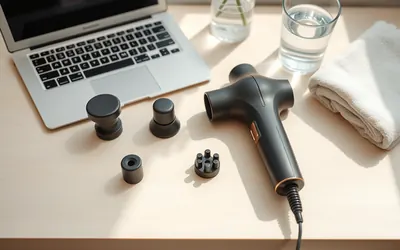
Attachments: Therabody's buying guidance suggests a softer or dampener head for areas near bone, a ball for general use and a thumb or bullet head for small spots. Check what is in the box, because the Theragun Prime ships with two attachments while some guns on our list include more.
Noise matters if you share a flat or use it early. Where brands publish a figure, Hyperice lists 48 dB for the Hypervolt 3.
The full numbers for every model are in our massage gun buying guide, compared on the specs the brands publish.
Try This: Open the brand's own page and look for the words amplitude and stall force. If either is missing, note it as not stated rather than guessing.
On the calves: pressure and time per spot
Set the speed according to your device's manual and sit down so you can see and reach the calf without balancing. Bob and Brad, whose how-to guidance we checked, advise about 10 to 20 seconds per spot and no more than 2 minutes per muscle, keeping the tool on muscle and off bony areas.
Pressure is easier to judge if you let the head rest with only the weight of the device behind it, then add a little from your hand. If your grip tightens or you notice you are bracing the leg against the tool, ease off. Some guns help you judge it: Therabody says the Theragun Prime gives real-time pressure feedback, and Hyperice says the Hypervolt 3 uses pressure sensor technology to guide your intensity.
Work slowly up the back of the lower leg in short passes, keeping the head on the calf muscle rather than the shin bone at the front. Follow your device's manual for which attachment to use; Therabody's buying guidance suggests a softer head for areas near bone.
Try This: Keep the handle loose and let the head travel rather than parking it in one spot; move on after about 10 to 20 seconds.
Feet and the plantar fasciitis phrase
You may see the phrase massage gun for plantar fasciitis in search results. The sources we checked do not cover that condition, and this article does not make health claims. If you have a diagnosed condition or an injury, check with a healthcare professional before using a massage gun, as both Therabody and Renpho advise for the conditions they list.
For the foot itself, the same general rules apply as anywhere else: keep the head on muscle and soft tissue, away from bone, and keep sessions short. Therabody's buying guidance suggests a softer or dampener head for areas near bone, and Bob and Brad advise skipping bony areas. Follow your device's manual for speed and attachment.
Therabody's precautions page says to seek medical advice before use if you have a recent injury or surgery, a bone fracture, open wounds or bruises, take blood-thinning medication or are pregnant, and it lists direct application to the face, head, throat, neck or genitals as a contraindication. Renpho says not to apply its device to the head, face, throat or cervical spine, and to consult a doctor first if you are pregnant or have a heart condition, a pacemaker or metal implants.
Read the safety page for your device, and read our medical disclaimer for how we frame all of this. It is general information, not medical advice.
Try This: Before you start on a foot, read your device's safety page and check the attachment list for a softer head.
How long, how often, and what the sources do not set
Bob and Brad advise about 10 to 20 seconds per spot and no more than 2 minutes per muscle. That is a short session, which makes it easier to repeat.
Frequency is the part the sources do not put a number on. None of the brand pages we checked publishes a use-it-this-many-times-a-week figure, so we are not going to invent one. If you run occasionally, you could tie a short session to the run rather than aiming for a strict daily habit; your device's manual overrides anything here.
Some devices build in a limit: Renpho says the Active+ switches off after 10 minutes on its own. That is a backstop, not a target.
Try This: Put the gun next to your running shoes so the session happens after the run, and stop when the two minutes per muscle are up.
Why this is not a paid placement
Fair question. The honest answer is that we have not hands-on tested these devices, and we say so in every guide. What we do is document: we open each brand's own US product page, record the specs it publishes, note the date we checked, and write "not stated" where a brand stays silent rather than guessing. That is why amplitude appears for Therabody's guns but not for Hyperice or Ekrin in our tables: those brands did not publish it on the pages we checked.
On placement: brands cannot pay for a spot in our guides, and picks are made on published specs, not commission rates. Some links in our buying guide are affiliate links, which may earn a commission at no extra cost to you, and the guide labels each one. This article contains no affiliate links; its links go to our own guide and disclaimer.
If something looks wrong or out of date, tell us through the contact form; each guide carries the date it was last checked. Start with the massage gun buying guide for the full spec table and safety links for each brand.
Try This: Open the guide and search the page for the words "not stated". The brands that stay quiet about a spec are usually the ones worth asking about before you buy.
The Bottom Line
Keep sessions short: Bob and Brad advise about 10 to 20 seconds per spot and no more than 2 minutes per muscle, on muscle and away from bone. The sources do not set a frequency, so tie it to your run and follow your device's manual. Compare models on the published specs in the buying guide.
General information only, not medical advice. Talk to your doctor before making big changes to your diet, exercise or sleep, especially if you have a health condition or take medication. See our medical disclaimer and editorial policy.