Massage Gun for Shoulders and Upper Back: Choosing One for Desk Days
Your shoulders are tight by the end of the workday and a massage gun looks like the fix. Before you buy, check whether you can reach your own upper back, where the brands say not to use one, and how loud it will be at your desk.

Most massage gun advice is about power. For desk-day tightness in the shoulders and upper back, the more useful questions are practical: can you hold it there, is it quiet enough to use at home, and where should it not go at all. If a foam roller has been your only tool and it feels like guesswork on the top of your shoulders, a handheld gun is easier to aim, but only if you can comfortably hold it there and use it safely.
This guide answers those with what each brand publishes. If you want the specs themselves explained, stroke length, speed and stall force are covered in our percussion massage gun specs guide, and the full side-by-side figures are in our massage gun buying guide. We have not tested these devices, and this is general information, not medical advice.
Start with reach: can you hold it on your own upper back?
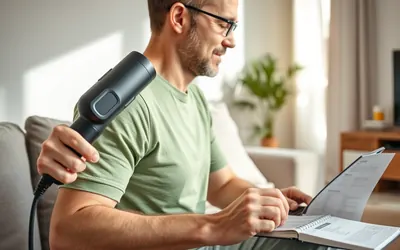
Shoulders and the upper back are awkward places to reach on yourself, so the first question is not power but whether you can hold the gun there for a minute without straining. Therabody's buying guide points to handle design for hard-to-reach areas such as the lower back, and the same logic applies higher up.
Weight is the other half. The RENPHO Active+ is listed at 1.5 lb with a 10 mm stroke, five attachments and a carry case. The Opove M3 Pro is listed at 2.43 lb. The Theragun PRO Plus is listed at 3.64 lb, which is a lot to hold at shoulder height for long. If reaching your own back is the main job, Ekrin lists a 15-degree angled handle on the B37 for better reach.
Try This: Test the reach with something of a similar weight: a full 16 oz water bottle weighs about a pound, two of them about two. Hold it against the top of your opposite shoulder for a minute; if your arm tires, favour a lighter gun or an angled handle over extra power.
The neck is off-limits: where the brands draw the line
A stiff neck after a long day is common, and it is exactly where the brands say not to use these devices. Therabody lists direct application to the face, head, throat, neck or genitalia as a contraindication. Renpho says not to apply its Ascend massage gun to the head, face, throat or cervical spine. Bob and Brad advise working on muscle only and skipping bones such as the spine.
So for desk-day tightness the target is the muscle across the top of each shoulder and the muscle beside the shoulder blades, away from the spine. If neck or shoulder pain lasts or keeps coming back, that is a question for a healthcare professional rather than a gadget.
Try This: Find the spot with your fingers first: if you can feel bone, move the head an inch or two onto muscle.
How deep for shoulders? The short version of the specs
Two numbers decide how a gun feels: stroke length, which is how far the head travels, and stall force, which is how hard you can press before the motor stops. Our percussion massage gun specs guide explains both in full.
For shoulders, the short version: compact guns with a 10 mm stroke give a lighter, buzzier pass, and Therabody lists 16 mm for the Theragun Prime and PRO Plus if you want more depth. Where brands publish stall force, the RENPHO Active+ states 50 lb and the Opove M3 Pro states 70 lb. If you like a gentle pass while you sit, 10 mm is plenty; if you like to lean in, a higher stated stall force matters more to you than a longer stroke.
Try This: Decide first whether you want a light pass while you sit or firm pressure you lean into. That one answer rules out half the list.
Noise: using it at your desk or with someone asleep nearby
If you plan to use it on a break at your desk, or in the evening with someone asleep in the next room, compare stated noise. Renpho states 45 dB or less for the Active+. Hyperice states 48 dB for the Hypervolt 3. Opove lists under 55 dB for the M3 Pro. Therabody did not list a decibel figure for its models on the pages we checked, which is a gap in the published data, not a verdict.
Try This: If quiet matters, use a single stated decibel figure as the tiebreaker between two models you already like.
Attachments for the shoulder blade area
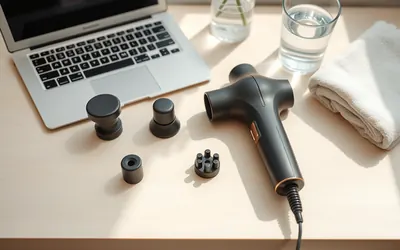
The shoulder blade sits just under the muscle there, so a softer head is useful. Therabody's own attachment descriptions are the simplest version: a dampener for tender areas such as around bones, a standard ball for general use and a thumb for precise spots.
Check what is in the box before you compare prices. Therabody's What's Included list for the Theragun Prime is the device, two attachments and a cable, so a softer head may be an extra purchase there.
Try This: Count the heads you would actually use on your shoulders, usually a ball and a soft head, before you count the ones in the box.
A short evening routine that follows the brand guidance
Short and light is the theme of every guide we read. Bob and Brad advise about 10 to 20 seconds per spot and a maximum of 2 minutes per muscle. A simple evening pass that stays inside that:
- Start on the lowest speed with the ball or a soft head.
- Glide slowly over the top of one shoulder, between the neck and the shoulder joint but not on the neck, for up to a minute.
- Do the same on the other shoulder.
- Beside each shoulder blade, one side of the spine at a time and never on it, for up to a minute each side, if you can reach or have help.
- Stop there. Your device's manual comes first, and our guide to using a massage gun safely has the full set of brand cautions.
Therabody says to ask a medical professional before use if you have a recent injury or surgery, open wounds or bruises, a bone fracture, take blood-thinning medication or are pregnant. Renpho adds a heart condition, a pacemaker and metal implants to its list of reasons to consult a doctor first.
Try This: Set a five-minute timer for the first few evenings so a short pass stays short.
Which kind of gun fits your desk day?
List prices are from each brand's own US site on the day we checked, October 23, 2026, and can change.
| If your evenings look like this | Look for | An example from our comparison |
|---|---|---|
| A light pass at the desk or on the sofa | Light weight, low stated noise, 10 mm stroke | RENPHO Active+, $79.99 |
| You cannot reach your own upper back | An angled handle | Ekrin B37 (v2) |
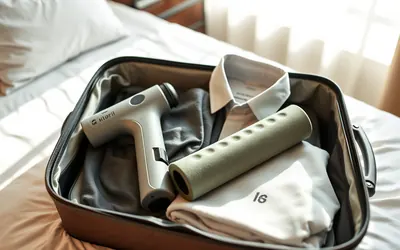
| Office one day, home the next | Small, light, with a travel case | Theragun Mini (3rd Gen), $219.99 |
| You like firm pressure | A published stall force | Opove M3 Pro, $129.99 |
| You want depth and pressure feedback | 16 mm stroke, a pressure readout | Theragun Prime (6th Gen), $329.99 |
Every spec side by side, including the ones brands leave out, is in our best massage guns guide.
Try This: Pick the row that sounds most like your evenings and compare only the two models closest to it; the rest of the list is noise for your use.
Why this is not a paid placement
A fair question, and here is exactly what this site does. We research published information rather than testing products, and we say so on every guide. The figures in our massage gun comparison come from each brand's own US product page, checked on a date printed at the top of the page, and where a brand does not publish a spec we write not stated rather than estimate.
Brands cannot pay for a spot in the guide. The page carries affiliate links, disclosed on it, which pay us a commission if you buy through them at no extra cost to you; that funds the site, and it is not the same as a brand buying a ranking. Every pick carries cons as well as pros.
If you have paid for gear before that ended up in a drawer, that is the cost this guide is trying to save you: buy for reach, weight and noise, and skip the specs you will not use.
Try This: Read the cons list on any guide before the pros: if a site cannot name a downside for its top pick, it is not comparing, it is selling.
Questions desk workers ask
Can I use a massage gun on my neck? No. The brands we checked list the neck, or the cervical spine, as a place not to apply their devices, as described above. Work the top of the shoulders instead, and ask a healthcare professional about neck pain that lasts.
Massage gun or foam roller for tight shoulders? We have not compared them hands-on. A foam roller works by lying or leaning on it, which suits the back and legs; a handheld gun can reach the top of the shoulders while you sit. If you already own a roller you find hard to use there, that is a fair reason to look at a light gun, starting at the budget end.
How long should a session be? Short: the guidance quoted above is 10 to 20 seconds per spot and no more than 2 minutes per muscle, so a whole shoulder routine fits in about five minutes.
Do I need the most powerful model? Not for a gentle evening pass. Reach, weight and noise decide whether you use it at all; extra power mostly matters if you like firm pressure.
What should I do next? Pick the row in the table above that sounds like your evenings, then compare those two or three models side by side in our best massage guns guide, which shows every published spec and the date it was checked.
Try This: Write down the one question you most need answered before buying, and check it on the brand's own page before you pay.
The Bottom Line
For shoulders after a desk day, choose by reach and weight first, noise second and power last, and keep every session short and off the neck. A light 10 mm gun covers a gentle evening pass; a stated stall force matters only if you like to lean in. Your next step is the side-by-side table in our best massage guns guide.
General information only, not medical advice. Talk to your doctor before making big changes to your diet, exercise or sleep, especially if you have a health condition or take medication. See our medical disclaimer and editorial policy.
Sources we checked
We opened each link below and compared it with the sentence that cites it, on the date shown. Maker and retailer pages state the maker's own specifications and claims; they are not independent tests, and we have not hands-on tested these products. Pages and prices can change after that date. Spotted something out of date? Tell us through the contact form.
- Therabody: 5 Things You Should Know About Massage Guns (checked October 23, 2026): Amplitude is how far a gun extends back and forth (Theragun: 16 mm); handle design matters for hard-to-reach areas like the lower back.
- RENPHO: Active+ Massage Gun product page (checked October 23, 2026): $79.99; 10mm; 50 lbs stall force; <=45dB; 5 heads; carrying case; 1.5lbs; 10 min auto-off; 18-month warranty on website orders only.
- Opove: M3 Pro Massage Gun product page (checked October 23, 2026): $129.99; 70 lbs max stall force; 12mm amplitude; 5 speeds; 6 attachments; 2.43 lbs; under 55dB; 4-8h battery; carrying case.
- Therabody: Theragun PRO Plus product page (checked October 23, 2026): $649.99; 16mm; five therapies incl. near-infrared LED; heat and vibration attachments; 3.64 lbs; Cold attachment $99.99 sold separately.
- Ekrin Athletics: B37 Percussion Massager product page (checked October 23, 2026): 15 degree angled handle for better reach, including your back; 5 speeds 1400-3200 RPM; up to 8 hours; 4 locking attachments; USB-C PD.
- Therabody: Safety, Precautions and Contraindications (checked October 23, 2026): Theragun contraindications include direct application to the face, head, throat, neck or genitalia; listed conditions (recent injury or surgery, open wounds or bruises, fracture, blood-thinning medication, pregnancy) need medical advice first.
- RENPHO: Ascend Massage Gun product page (Disclaimer section) (checked October 23, 2026): Do not apply to head, face, throat or cervical spine; consult a doctor first if pregnant or with a heart condition, pacemaker or metal implants.
- Bob and Brad: How to Use a Massage Gun (checked October 23, 2026): 10-20 seconds per spot, max 2 minutes per muscle; muscle only, skip bones like the spine and kneecaps.
- Therabody: Theragun Prime (6th Gen) product page (checked October 23, 2026): $329.99; 16mm amplitude (the PRO Plus page lists 16mm too); 5 speeds plus more via app; real-time pressure feedback; What's Included: device, 2 attachments, cable.
- Hyperice: Hypervolt 3 product page (checked October 23, 2026): $249; QuietGlide at 48 dB; 5 speeds 1500-2500 RPM; pressure sensor technology; up to 4 hours; 18V wall charger; carry case.
- Therabody: Theragun Mini (3rd Gen) product page (checked October 23, 2026): $219.99; 10mm; travel lock; soft travel case; Dampener for tender areas like around bones; Standard Ball for full-body massage; Thumb for areas needing precise treatment.