Resistance Band Types Explained: Tube, Mini Loop, Fabric, Flat
Five shapes, one confusing shelf: here is what each band type is for, how brands measure pound ratings, and what latex labels actually mean.
 By WellnessTrim Editorial Team
8 min read
By WellnessTrim Editorial Team
8 min read
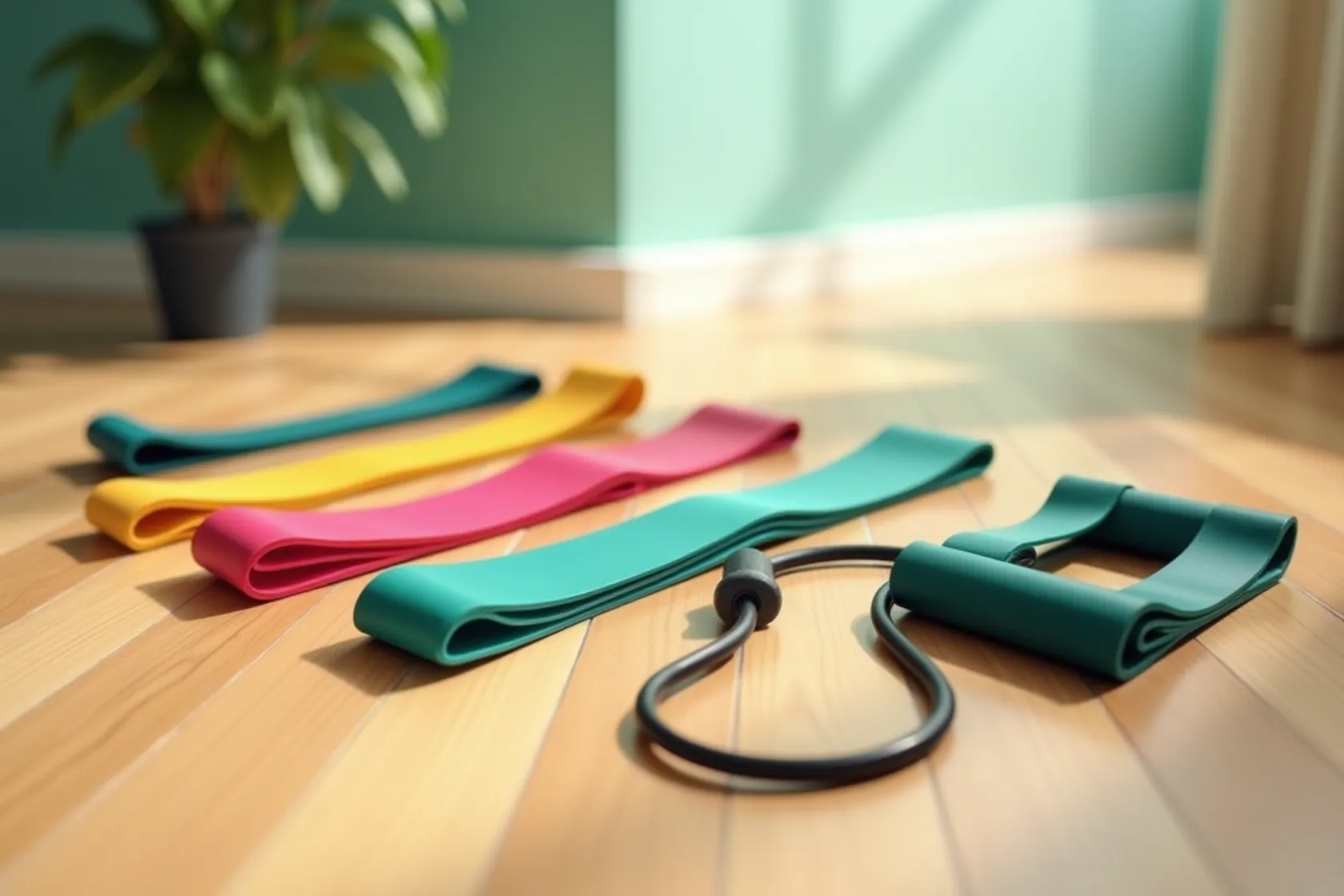
Resistance band shopping gets confusing quickly, because "resistance band" covers five different products: tubes with clip ends, mini loops, fabric hip bands, long loops, and flat bands with built-in grips. Each shape is built for a different job, and the shape matters far more than the colour.
This article walks through what each type is, how to read the pound ratings brands publish, why those numbers are not comparable across brands, and what latex labels do and do not tell you. Specs and prices come from each brand's own US site; to see how specific models compare, our best resistance bands guide lists each pick's rating exactly as the brand states it.
The five types at a glance
Resistance bands come in more shapes than the shop shelf suggests, and the shape decides what a band is good for.
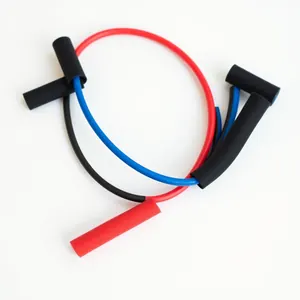
- Tube bands with clip ends. Rubber tubes that clip onto handles, ankle straps or a door anchor. Sets like the Bodylastics five-band set are stackable: several bands can clip onto one handle at once.
- Mini loop bands. Small flat closed loops, roughly 9 to 12 in around, used around the legs. Perform Better says its 9 in loops suit "lateral steps, leg extensions, shoulder stabilization, and dynamic warm-ups".
- Fabric hip bands. Woven loops, often 3 in wide, with a textured interior instead of bare rubber.
- Long loop bands. Big loops around 40 to 41 in, used for pull-up assistance, stretching and heavier pulling.
- Flat bands with loops. A flat strip with built-in grip loops along it, such as the TheraBand CLX, so no handles are needed.
Try This: Buy for the movement you actually do. If you want rows, presses and leg work at home, a tube set with handles and a door anchor covers the most ground; if your routine is warm-ups and lateral steps, a mini loop is the cheaper start.
Tube bands with clip ends
Tube bands are the closest thing to a home cable machine. The Bodylastics 5 Band Pro Series Set includes five bands stated at 3-10 lb, 5-20 lb, 8-30 lb, 13-50 lb and 19-80 lb, plus two handles, two ankle straps, a door anchor and a bag. Each band measures about 54 in from clip end to clip end when it is not stretched.
The set's headline figure, "3 to 190 lbs Max Tension" in the product title, is not one band's pull. Bodylastics says set totals are "calculated by adding up the resistance of all the bands in the set and then multiplying by 2 to account for each end of the bands". Clipping several bands onto a single handle is the point of the design.
Each tube has an inner inelastic Snap Guard cord. Bodylastics says it "can help prevent the user from over stretching the band" and "can help prevents the band from flying at the face or extremities in the rare case that the band does snap". The page price is $49.97, and Bodylastics says Amazon handles all of the ordering and shipping. Its warranty page says a band or component that "snaps, breaks, or fails due to regular use within the first 90 days" is replaced free of charge; after 90 days replacements are bought through Amazon at a discounted price.
Try This: Check how a set's total is calculated before comparing it with another brand's number. Adding every band together and doubling it, as Bodylastics does, produces a much larger figure than rating one band at a time.
Mini loops and fabric hip bands
Mini loops are the small flat bands people loop around the knees or ankles. Fit Simplify's five-band set comes in extra light, light, medium, heavy and extra heavy, each 12 in by 2 in and made from what the brand calls "100% natural latex". The set is $15.95 and includes a carry bag, an instruction guide, a 41-page eBook and online workout videos; Fit Simplify backs it with a "Lifetime guarantee" and a full refund if the bands "don't work out for you for any reason".
Perform Better's First Place Mini Band is smaller at 9 in long by 2 in wide and stretches to "Up to approximately 2.5× original length". A four-pack has one band in each level — light (yellow), medium (green), heavy (blue) and extra heavy (black) — and was on sale at $10.95, down from $12.50, when checked. Singles run $2.75 to $3.50 and 10-packs $21.95 to $27.95. The brand describes the band as "Closed-loop band containing natural rubber latex".
Fabric hip bands address a different problem: bare rubber loops can roll or dig in. The Rogue Hip Band is a 3 in wide loop made from a "woven polyester-elastic blend" and is "Latex-free", with a "textured grip on the interior to prevent slipping". It comes in one resistance level, medium, and three sizes — 12 in, 14 in and 16 in — at $17.50 each. Rogue's fit guide sizes by thigh: small for 18-22 in, medium for 22-26 in and large for 26-30 in, measured 2-3 in above the knee.
Try This: Measure before you buy a fabric band. Rogue sizes its hip band by thigh circumference, and the fit guide notes the smaller size gives more tension while the larger size gives more range.
Long loop bands
Long loops are the big bands used for pull-up assistance, stretching and adding resistance to lifts. Perform Better's First Place Superband is a 40 in loop (80 in end to end) sold as a single band in 11 widths, from 1/4 in at an approximate 10-15 lb up to 4 in at 160-245 lb. The brand says those ranges are "based on manufacturer testing at 100–200% elongation", and the band is "Natural rubber latex". Per-band prices run from $13.95 to $79.95.
Rogue Monster Bands are 41 in long in eight sizes, rated from #0 orange at 9 lb to #7 silver at 225 lb. Rogue says the resistance is "calculated at a 100% stretched length" — twice the band's resting length — and calls the figures "reasonable estimates due to variances in manufacturing". The $75 Pull-up Package bundles a #3 (40 lb), #4 (65 lb) and #5 (95 lb).
Try This: With long loops, buy the widths you will actually use rather than a full range. If you only want a little help on pull-ups, thinner bands cost less and are easier to control.
Flat bands with built-in loops
A flat band with loops is a strip of rubber with a row of built-in grips along it, so you hold the band itself instead of a handle. The TheraBand CLX is 5 ft long and comes in seven levels, from Light to Elite. TheraBand describes it as "Latex-free, powderless" and says the loops give "Multiple unique grip options for open, close, or no grip exercises". No handle or anchor is included; the CLX Anchor is sold separately.
TheraBand explains its levels using force-elongation: a 2-foot green band stretched to 4 feet, or 100% elongation, gives 4.6 lb. The brand says each step up represents a "consistent pull-force increase of 25% in the clinical range (Tan through Black) and 40% in the advanced range (Silver and Gold)". Single 5-foot bands were listed at $11.07 (Light) to $17.51 (Elite).
Try This: Keep a note of the level you use. CLX levels are named rather than numbered, so "Medium" only means something within TheraBand's own range.
How to read pound ratings
A pound rating describes the pull at a particular stretch, not a fixed weight you are lifting. TheraBand's example makes this concrete: a 2-foot green band at double its length gives 4.6 lb. Bodylastics gives its own example — the 5 lb green band "gives 5 lb at twice its length and 10 lb at 4 times its length".
Because of that, brands do not all count the same way:
- Per band, at a stated stretch. Rogue rates Monster Bands at a 100% stretched length; Perform Better gives Superband ranges across 100–200% elongation.
- Whole set, doubled. Bodylastics adds every band in a set together and multiplies by 2 "to account for each end of the bands" to reach its 190 lb set figure.
- Named or colour levels with no pounds. Fit Simplify uses extra light to extra heavy, Perform Better's mini bands use light to extra heavy, and TheraBand CLX uses seven named levels.
The practical consequence is that a "190 lb" set figure and a "160-245 lb" single band are not the same kind of number, and comparing them directly tells you very little. Compare levels within one brand, using that brand's own width or colour chart. To see how each pick is rated, our best resistance bands guide lists the figures exactly as each brand publishes them.
Try This: Before buying, read the brand's FAQ. The stretch a rating refers to — 100%, 200%, or twice the band's resting length — is usually explained there and rarely on the packaging.
Latex labels, inspection and storage
Most rubber bands are natural rubber latex. Perform Better lists its mini band as "Closed-loop band containing natural rubber latex" and its Superband as "Contains natural rubber latex"; Rogue's Monster Bands are "Natural Latex Rubber". TheraBand's care and safety page notes that latex products may cause allergic reactions. If that is a concern, look for bands the maker labels latex-free, such as the TheraBand CLX ("Latex-free, powderless") or the Rogue Hip Band ("Latex-free").
Inspection is a habit rather than an occasional check. TheraBand says to inspect the product for damage before and after each use and not to use it if it is torn, punctured or nicked, to make sure the band is securely anchored to a sturdy object, to "Wear eye protection", never to use the band "in any way that may cause it to snap towards the head", and not to "over-stretch the product (more than 3 times its length at rest)". Perform Better says to "Inspect before each use and discontinue use if nicked, cracked, or damaged", to avoid sharp edges and abrasive surfaces, and not to stretch beyond a safe working range.
Bodylastics' manual adds door-specific guidance: when using the door anchor, place it "on the hinge side of the door and lock your door", check components for damage before use, and never clip a band to an anchor loop. It also notes the bands "are not snap proof" and should not be stretched more than 3-4 times their resting length. On storage, Perform Better says to "Store in a cool, dry area away from direct sunlight"; TheraBand adds a cool, dry place out of direct sunlight, and advises unhooking bands from anchors after use. Bodylastics warns against storing bands in direct sunlight or extreme hot or cold temperatures. If you are working around an injury or a health condition, check with a healthcare professional first.
Try This: Write the check into your routine: inspect bands before and after each use, especially where they attach to a handle, ankle strap or anchor, and retire any band that is torn, nicked or cracked.
The Bottom Line
Match the band type to the job first: a tube set with handles and a door anchor covers the most ground at home, mini loops handle warm-ups and leg work, and long loops are for pull-up assistance and stretching. Read pound ratings as a pull at a stated stretch and compare them only inside one brand, and check the latex label if latex is a concern. Inspect bands before every use, follow the maker's care instructions, and see a healthcare professional first if you have an injury or condition.
General information only, not medical advice. Talk to your doctor before making big changes to your diet, exercise or sleep, especially if you have a health condition or take medication. See our medical disclaimer and editorial policy.