Leak Proof Water Bottle: What the Claim Actually Covers
“I’ve had multiple water bottles leak in my work bag and ruin a laptop sleeve” — so before you buy another leak proof water bottle, you want to know what the claim actually covers.
 By WellnessTrim Editorial Team
7 min read
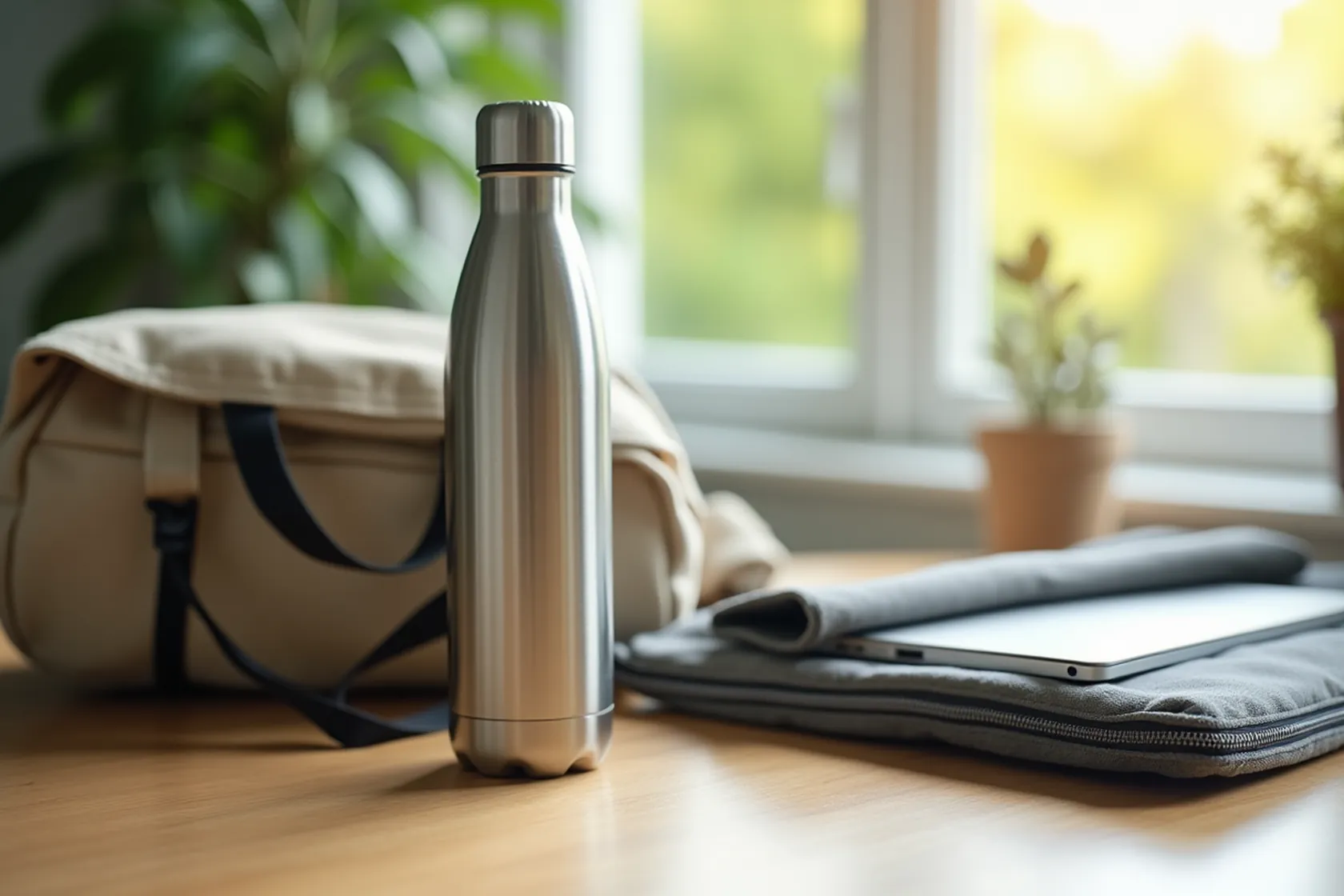
You have already paid for this lesson: bottles sold as leak proof, a work bag, and a laptop sleeve that came out damp. So the words “leak proof water bottle” are no longer something you take on trust. You want the exact wording, the condition attached to it, and an honest note about what nobody tested.
This article walks through what leak-proof claims on insulated bottle pages actually say, what our own research covers and what it does not, and the checks worth doing before a bottle rides next to a laptop. If you want the side-by-side comparison, it lives in our best insulated water bottles guide.
What a leak-proof claim actually covers
On the brand pages we read, “leak proof” is almost always a conditional statement. It describes the lid in one particular state, not the bottle in every state. The wording is worth reading closely:
- Hydro Flask says its 32 oz Wide Mouth is “Leakproof when closed.”
- Simple Modern says the Summit’s straw lid is “leak-proof when the nozzle is in the closed position.”
- CamelBak describes the Chute Mag cap as having “a magnetic top that stows securely out of the way when open and is leak-proof when closed.”
- Takeya says its Spout Lid “securely screws closed for zero leakage.”
- Owala calls the FreeSip “Leak-proof” and says the carry loop “also doubles as a lock when closed.”
None of those sentences comes with a method. There is no test, no duration, no description of which way the bottle was held. That makes the honest reading a narrow one: the claim covers a lid that is shut, and on lids that have a lock, locked. It does not tell you what happens when a button gets pressed inside a crowded bag, or when pressure builds from a drink the lid was not designed for — Simple Modern warns that pressure may build in the bottle with hot liquids, “causing leaks or spills.”
So the useful question is not “is it leak proof?” but “what has to be true for it to stay leak proof?” A lid that screws shut, like Takeya’s, or one with a lock, like the Owala loop, answers that better than a badge does.
Try This: Look for a lock or a screw closure, not just the phrase: Owala’s carry loop doubles as a lock, and Takeya’s spout lid screws shut.
What our research covers, and what it does not
Our guide was researched, not hands-on tested, and the method note on the page says so. Specs come from each brand’s own US product page, checked on October 11, 2026, with prices as shown on that date. We did not fill, shake, invert or drop these bottles. We have no leak-test results of our own to show you, and we are not going to dress a spec sheet up as one.
What we did do is record the exact leak wording for each bottle and the condition attached to it, which is how you can tell “leakproof when closed” from “screws closed for zero leakage.” We also read the warranty pages, because that is where leakage sometimes appears in the small print.
Iron Flask’s warranty page, for example, excludes “leaking after more than a year of usage” while covering manufacturing defects such as leakage and insulation flaws in normal use. Simple Modern says broken lids and drinkware that has lost its insulating properties are covered, but not dents and scratches. A conditional leak claim plus a conditional warranty is the real picture — and it is more useful to you than a slogan.
Try This: Check the warranty’s leak clause before buying: Iron Flask’s excludes leaking after more than a year of use.
A leak proof water bottle checklist for a work bag
Five checks, in the order that saves a laptop sleeve:
- Read the condition, not the badge. If the wording says “when closed,” the bag question becomes “will it stay closed?” A lock or latch answers that; a claim on its own does not.
- Think about the lid you will actually use. Straw and flip lids rely on you snapping a nozzle shut — Stanley says of the IceFlow, “Flip up the built-in straw to sip, snap it shut for leakproof carrying.” Screw caps rely on you turning them all the way every time.
- Check what the brand allows inside. Simple Modern states its bottles are “Not intended for Hot Liquids: Pressure may build in the bottle causing leaks or spills,” and Owala says the stainless FreeSip “shouldn’t be used with hot, carbonated, or perishable liquids.” A bottle that leaks under pressure is not a broken seal; it is a bottle being used outside its instructions.
- Clean it the way the brand says. Simple Modern tells you to disassemble the bottle, lid and straw and wash the lid in the open position. That routine also lets you look at every part and put it back together properly instead of guessing.
- Do a dry run at home, not in your bag. Fill it, close and lock it, and lay it on its side on a towel before it ever shares a pocket with a laptop. Then carry it in an outer pocket for the first few days.
Try This: Fill, close, lock, and lay the bottle on its side on a towel at home before it goes anywhere near a laptop.
Insulated hours and leak claims answer different questions
An insulated water bottle’s headline number is about temperature, not sealing. Hydro Flask claims “24 hours cold, 12 hours hot” for its 32 oz Wide Mouth; CamelBak claims 32 hours cold for the 32 oz Chute Mag; Stanley claims 12 hours cold and iced for 2 days on the IceFlow tumbler. Those figures describe the double-wall vacuum insulation, and they say nothing about whether the cap holds.
The reverse is true too: a bottle with a more modest cold claim can have the more secure lid. Judge the two specs separately. Choose insulation hours for the length of your day, and judge the lid on its closed-and-locked wording and on whether the brand rates it for what you plan to pour in.
Read the hours as brand claims rather than measured results. How full the bottle is, how often you open it, how much ice you add and the temperature around you all sit outside the claim, and none of the pages we read explains the conditions behind the numbers.
Try This: Pick insulation hours for the length of your day, then judge the lid on its closed-and-locked wording.
Insulated water bottle with straw: where the wording matters most
If you drink more from a straw, an insulated water bottle with straw saves you unscrewing a cap every time. That convenience is exactly why the leak wording deserves a second read: every straw-lid claim in our research is tied to the nozzle being shut.
- Simple Modern (Summit, 22 oz and 30 oz): straw lid is “leak-proof when the nozzle is in the closed position.”
- Stanley (IceFlow 30 oz): a “Leakproof flip straw lid” that snaps shut for carrying — note that this is a handled tumbler rather than a classic bottle.
- Owala (FreeSip): push-button flip lid described as “one push and I’m locked tight,” with the carry loop doubling as a lock.
Two practical consequences. A straw lid that pops open with a button is the one most likely to be open when you do not expect it, so a lock or a firm snap matters more here than anywhere else. And straw lids are often cold-only: Owala, Simple Modern and Stanley all steer those lids away from hot drinks, which is worth knowing before you fill one with tea and zip it into a bag.
Try This: If you want a straw, choose one with a lock or a firm snap-shut nozzle, and keep it upright in your bag until you have tested it at home.
Why this isn’t a paid placement, and what we did not test
Fair question, and the answer is structural rather than reassuring. We research published information — brand product pages, warranty pages and listings — and we compare what they say. We do not claim to have tested the bottles, and the page states that plainly. Brands cannot buy a spot in the guide.
We do earn a commission from some links, at no extra cost to you, and we disclose it on the page. What that money does not buy is a verdict. When two sources disagree, we say so rather than average them: Stanley’s brand page claims 12 hours cold and iced for 2 days for its 30 oz IceFlow, while an Amazon listing for a newer version claims 20 hours cold and iced for up to 3 days. The brand’s page for that version returned an error when we checked, so we left the newer claim out instead of blending it in.
We also flag what we could not confirm. Takeya’s page lists no weight, Hydro Flask’s product page does not mention BPA, and Amazon’s listing for the 32 oz Owala says the bottle is not compatible with standard car cup holders. Where a page is silent, we leave the gap visible instead of filling it with a guess. That is also why we will not tell you a bottle is leak proof: we can show you what the brand says, what it attaches the claim to, and what nobody published. The full side-by-side, with the exact leak wording for each bottle, is in our best insulated water bottles guide.
Try This: Judge a review by what it admits: look for a method note, a check date and a list of what was not tested.
The Bottom Line
Before a bottle goes in a bag, read the leak claim as a condition, choose a lid that locks or screws shut, and check the warranty’s leak clause. Then test it on a towel at home while your laptop is somewhere else. The exact wording for every bottle we compared sits in our best insulated water bottles guide.
General information only, not medical advice. Talk to your doctor before making big changes to your diet, exercise or sleep, especially if you have a health condition or take medication. See our medical disclaimer and editorial policy.