
Choose Your First Resistance Bands
Every list you read ranks different bands and quotes different pound numbers. The real question is simpler: will this band work with your routine and your setup? This page walks you through your first decision right here, for free: the right band shape for your routine, what a resistance label really measures, and the full cost. If you want the same method on paper for every band you compare, the printable workbook is further down.
- Step 1 on this page: routine first, or ready to shop?
- Three questions to answer before you compare two bands
- Optional: the 6-page printable workbook and decision sheet
Step 1: routine first, or ready to shop?
Before you open a single product page, write down two things: one movement your planned routine uses, and the band shape the routine specifies for it. That takes about a minute, and it decides everything after it.
- You can name both: you are ready to shop. Turn them into one requirement sentence (below) and move on to the three questions.
- You cannot name one or both: write “routine first” and pause shopping. That is a useful result, not a failure: you have found the missing piece before spending money. A shopping list cannot fill a gap in exercise instruction, so get the routine (or ask its instructor or maker which band it needs) before you buy. No routine yet? Day 3 of our free 7-Day Healthy Living Guide has a 10-minute standing routine with no equipment, so you can start moving while you decide.
The requirement sentence
“For [routine / movement], I need [band type] with [grip or accessory], usable in [space], within [total budget]. I must confirm [one critical unknown].”
Worked through: one fictional example
This example is hypothetical, from the workbook; the figures are not current prices. A reader’s routine specifies a mini loop. Their sentence reads: “I need a mini loop with correct dimensions and a suitable starting level, below $30 total. Size still needs confirmation.”
- What the sentence does: it rules out tube sets straight away, even cheaper ones, because they are the wrong shape for this routine.
- The test: could someone use your sentence to reject an unsuitable listing? “Good quality” is too vague to reject anything. An accessory that appears in a photo but not in the contents list counts as unresolved.
- The open question (“size still needs confirmation”) is what you ask the maker or seller before you buy.
You have made your first decision when you have written either “routine first” or one requirement sentence like this. No purchase is needed for either.
Three questions to answer before you compare two bands
Once you have a requirement sentence, pick two candidates of the same shape and answer these for each. Write “?” wherever the maker or seller has not said.
- Does it fit the job and the setup? Check it against your sentence: the shape, the grip, any anchor, and the space it needs, as stated in the product manual. Do not assume a door or fitting is suitable. Cross out a candidate that fails an essential requirement.
- What does its resistance label actually measure? A label may describe one band at a stated stretch, a range, named levels, or a whole set added up. Bodylastics, for example, says its system total adds up every band’s rating and then doubles it, for both ends of the band. So compare levels only within one brand, on that brand’s own chart. This page does not choose a starting level for you: ask for guidance on your routine.
- What does it cost in full, and how do you get out? Add the item, any accessories your setup actually needs, delivery and tax, in one currency. Then read the seller’s return deadline, the condition rules and who pays for returns, and note the warranty separately.
Then decide: buy only when one option meets your essential requirements and budget with no open suitability or safety question. Otherwise ask the one question that would settle it, or wait. In the workbook’s hypothetical example, option A is $5 cheaper but its return terms are missing, so the decision is to ask about A first; waiting is allowed.
The five band shapes at a glance
Use the shape your routine names as your first filter. The middle column is what our band types guide says each shape is good for; the right-hand columns are what to check before you compare prices.
| Band shape | Good for (our guide) | Check against your routine | How makers state resistance |
|---|---|---|---|
| Tube with clip ends | Rows, presses and leg work at home, with handles, ankle straps and a door anchor | Handles and attachment points; what accessories are included | Per band, with set totals added up and doubled |
| Mini loop | Warm-ups, lateral steps and leg work | Whether your routine specifies a short closed loop | Named or color levels, no pound figures |
| Fabric hip band | Leg work where a bare rubber loop rolls or bunches | The maker’s size guide and stated materials | One level; the size sets the tension |
| Long loop | Pull-up assistance, stretching and heavier pulling | Required length, width and intended setup | A range across 100–200% stretch, or one figure at 100% |
| Flat band with loops | Travel, and changing grip without handles | Grip positions and any separately sold anchor | Named levels, explained with a force-stretch example |
Matching your routine to a row: if your routine’s moves include rows or presses, read the tube-band row first; for lateral steps, the mini-loop row; for leg work where a rubber loop rolls, the fabric hip band row; for pull-up assistance or stretching, the long-loop row; for travel, the flat-band row. Then confirm the shape your routine actually names.
“Fabric” does not settle latex. Most bands contain latex. If that matters to you, look for explicit material wording, such as a band labeled latex-free, rather than the word fabric on its own. Before you use any band, read its manual and inspect it; Bodylastics, for example, says not to use a band with cracks or splits.
How we work: our band guides compare what makers publish on their own US sites; the band facts in this table were checked on October 12, 2026. We have not tested these bands hands-on, and brands cannot pay for a place on our pages.
Want it on paper? The printable workbook
Everything above, as a reusable printable method: the same steps, with space to write, a decision sheet you can print for every pair of bands you compare, and three copy-and-fill templates. The workbook is 6 pages, one step per page. Open it first.
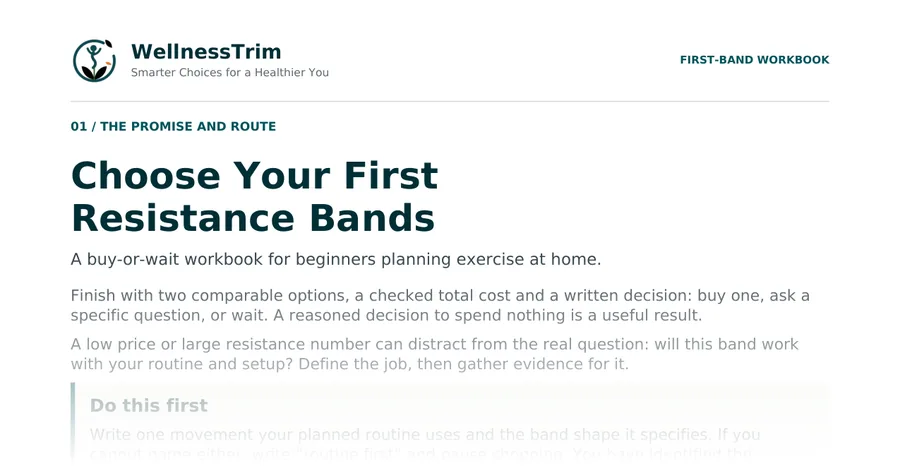
| Page 1 | The promise and route. What you finish with, the “Do this first” task, the five-step route and what to bring. |
|---|---|
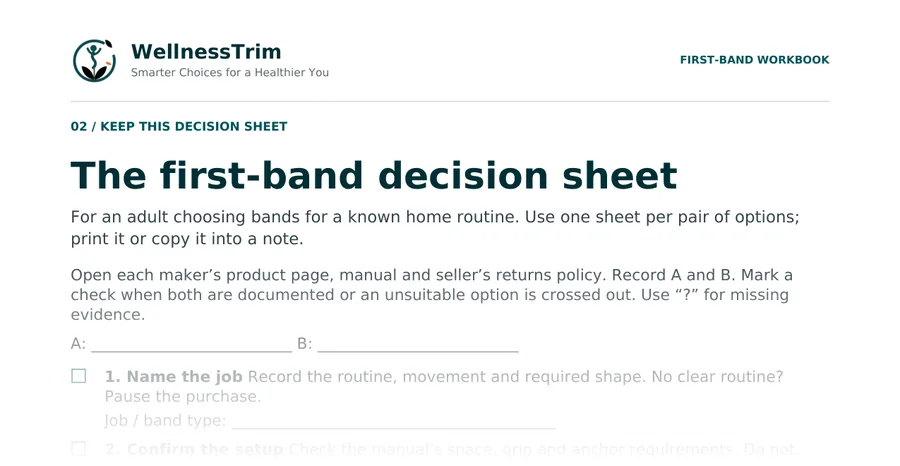
| Page 2 | The decision sheet. Seven checks for two options, A and B, and a completion test: buy, ask or wait. |
| Page 3 | Define the job. A band-shape filter (tube, mini loop, fabric hip band, long loop, flat band with loops) and a requirement sentence to copy, with a hypothetical example. |
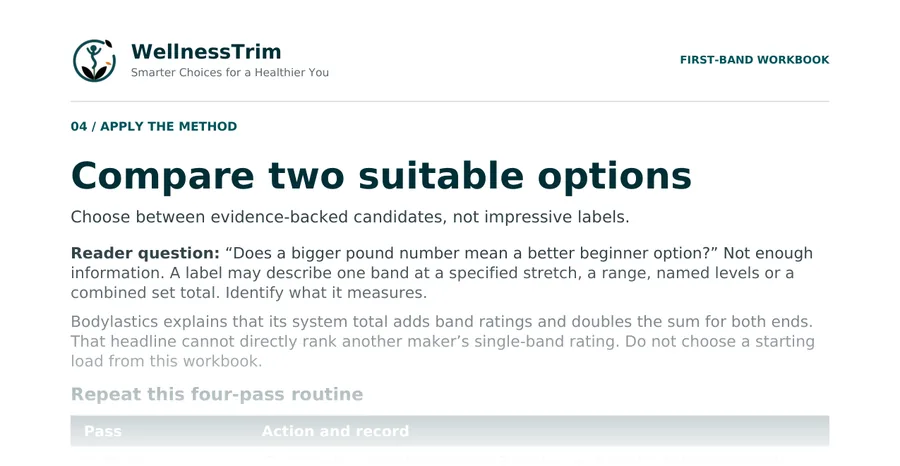
| Page 4 | Compare two options. How to read resistance labels (a bigger pound number is not a shared scale) and a four-pass routine: match, capture, cost, decide. |
| Page 5 | Three templates. A question for the maker or seller, a complete-cost line and a buy-or-wait decision note. |
| Page 6 | Close the decision. What to do when the decision stalls, and a worked example with illustrative prices. |
The decision sheet is 1 page: the same sheet as workbook page 2, on its own so you can print one for each pair of options you compare. It records seven checks for option A and option B: the job, the setup, materials and size, the resistance label, the complete price, the exit terms and the evidence gaps. Its page number (02 / 06) is the workbook page it comes from.
How long it takes: there is no set time. The workbook says to go at your own pace; most of the work is finding each maker’s manual, size chart and returns page and writing down what they say.
The top of three real pages, not mock-ups. The full pages are in the free PDFs.
Get the free workbook and decision sheet
Two PDFs, emailed to you. Nothing to buy to finish them.
This workbook or the 7-Day guide: which first?
Start with the free 7-Day Healthy Living Guide if you wrote “routine first” in step 1. It builds daily habits at home, and its own page says there is nothing to buy.
Use this workbook when you already follow a routine that calls for bands and you are about to buy. It does not teach exercises; it helps you choose and compare.
Shopping for other gear too? The one-page resistance band buying checklist is one of the nine on our Home Gear Buying Checklists page; the workbook is the longer, step-by-step version of that decision for bands.
Questions about the workbook
Do I have to buy anything?
No. The workbook ends with a written decision: buy one, ask a specific question, or wait. In the workbook’s words, a reasoned decision to spend nothing is a useful result. No purchase or workout is needed to complete it.
Will it tell me which band or resistance level to buy?
No. It is a shopping aid, not an exercise prescription, and it does not choose a starting load. It shows you how to compare two options on what their makers publish. If you want candidates to look at, our resistance band comparison lists seven bands and sets from published specs (it contains affiliate links).
What do I need before I start?
A routine you can follow, a spending limit, two product pages and something to take notes in. If you cannot yet name one movement your routine uses and the band shape it specifies, the workbook’s first step is to pause shopping and find the routine first.
I have a health condition, an injury or a latex allergy. Is this for me?
Get qualified guidance before you choose or use bands. The workbook says the same, and it reminds you to follow the exact product manual. See our Medical Disclaimer.
Read before you shortlist
- Resistance band types explained: which shape does which job, and why pound ratings differ between brands (the workbook’s pages 1 and 3 point here).
- Best resistance bands, compared: seven bands and sets from published specs; recheck details with the seller (contains affiliate links).
This is a shopping aid, not an exercise prescription or medical advice. Follow the exact product manual, and if a health condition, injury or latex allergy affects your choice, get qualified guidance first. Written by the WellnessTrim editorial team; see our editorial policy.